

Energy Industry Training Webinars
Educate your staff to improve their energy industry knowledge for success.
Customer sales
Utility negotiations
Management investment approvals
Strategic planning meetings
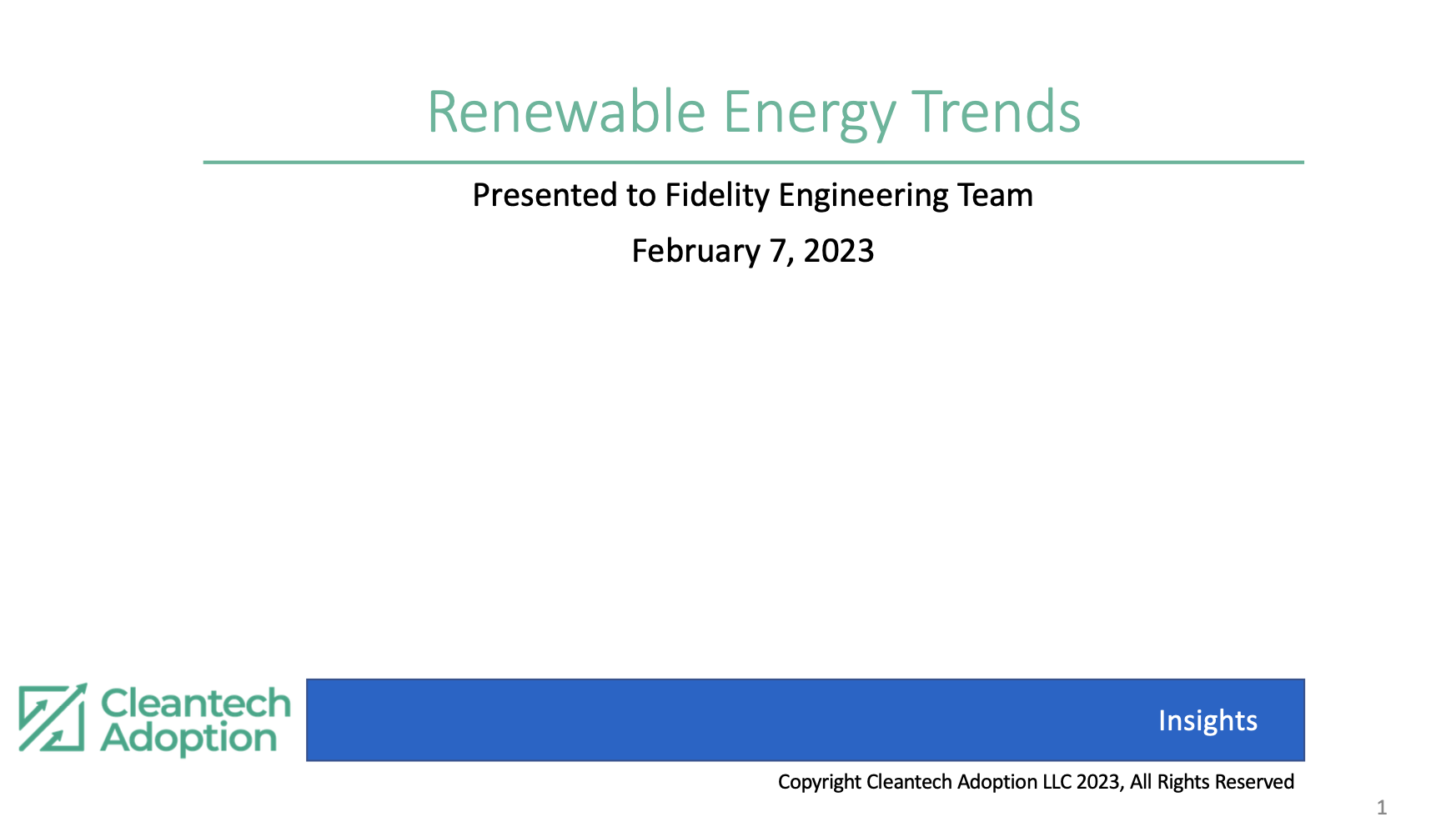
Presentations to Help Your Employees Understand the Energy Industry
Strategic webinars train sales and development staff on industry trends and strategic forces, enabling them to influence executive decision-makers.
The explosion of rapidly changing news, policies, and technologies overwhelms most employees in their day-to-day roles. They have an impossible task to keep up with industry changes caused by:
Federal, state, and municipal government policies that change with every election;
Rapid global innovations from new entrants in China, Europe, and the U.S.;
Volatile energy prices from unpredictable geopolitical wars;
Changing bond rates, bank interest rates, import tariff rates, and Federal Reserve policies; and
Social media and public relations campaigns funded by the fossil-fuel industry that whip up opposition to clean technology projects.
Staff Training Success Factors
-
Step 1: Identfy Sales Staff Needs
Webinars should be customized to:
Identify executive training goals for attending employees;
Identify regulations and policies that support or hinder the firm’s plan;
Address the major competitors’ market position;
Identify the company’s sensitivity to energy price volatility;
Identify the types of trends that are most concerning to staff; and
List risks that are of the highest importance to staff.
-
Step 2: Deliver a Custom Webinar
Webinars should:
Tell a story showing the path from risks to opportunities to actions;
Provide a Call-to-Action for change;
Provide charts and graphs showing the magnitude of the issues;
Keep slides simple and easy for employees to grasp;
Provide verifiable links to all data slides and facts; and
Provide additional resources for further reading.
Scenario Planning provides narratives of alternative futures

Creating a change narrative for staff, customers, or policymakers requires a view of the industry's future direction. If the future isn't changing, then businesses, customers, or policymakers don’t need to change.
Shell made future-oriented strategic business planning famous by developing scenario plans for oil field investments under geopolitical uncertainty. Cambridge Energy Research Associates (CERA) used the Shell process to develop 20-year scenario narratives for the utility and energy industries. I worked at CERA to develop a 20-year scenario analysis for the electric utility industry.
While a formal scenario planning process is not part of the strategic webinar services, the basic CERA framework provides plausible futures that companies should consider for future business plans. The process points to the possible changes to expect, from an analysis of the following five elements:
Predetermined Factors. Identify the factors that are known and unlikely to change in the foreseeable future. Examples include demographics, such as the average age and number of households, as well as the age, type, and number of cars, and the incomes of population segments.
Driving Forces. List the major societal or macro forces of change. Examples include the rise of AI, the rise of authoritarian governments, the resurgence of nationalism, the increase in trade protectionism and tariffs, or the adoption of a new technology.
Prime Movers. Identify the individuals or organizations that can substantially influence the driving forces, often by altering the “rules of the game.” Examples include the President of the United States, Congress, State Governors, business leaders, regulatory agencies, the U.S. Supreme Court, environmental groups and advocates, and international governmental bodies.
Major Uncertainties. Brainstorm the key factors whose timing and effect (up or down) are uncertain. Examples include future interest rates, commodity energy prices, the speed of technology adoption (such as advanced electric vehicles, nuclear fusion, or plug-and-play home virtual power plants), the start or cessation of wars, or the pace of climate change.
Wild Cards. Use creativity to anticipate unpredictable events, such as Russia's invasion of Ukraine. The purpose of considering wild cards is to brainstorm potential threats or opportunities that seem unlikely, but could have a major impact on future plans. Using wildcards stress-tests the strategic path, checking the plan’s robustness in responding to unexpected events.
Each consideration of the future plan begins with an evaluation of the five elements, accounting for current and foreseeable trends.